
Her Need: Financial Support
People often marry for the financial security that their spouse provides them. In other words, part of the reason they marry is for money. Is financial support one of your important emotional needs?
It may be difficult for you to know how much you need financial support, especially if your spouse has always been gainfully employed. However, what if, before marriage, your spouse had told you not to expect any income from him or her. Would it have affected your decision to marry them? Or what if your spouse could not find work, and you had to financially support him or her throughout life? Would that withdraw love units?

Captain Charles A. Lindbergh, Missouri National Guard, and members of his National Guard unit, the 110th Observation Squadron, after he flew solo across the Atlantic Ocean, 1927
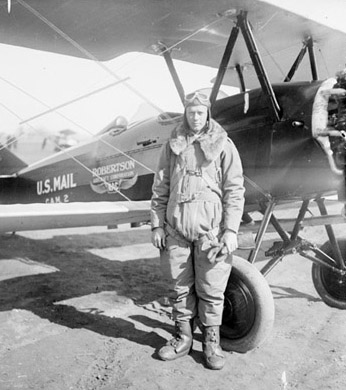
Lindbergh was working as an airmail pilot when he first dreamed of flying across the Atlantic
You may have a need for financial support if you expect your spouse to earn a living. You definitely have that need if you do not expect to be earning a living yourself, at least during part of your marriage.
What constitutes financial support? Earning enough to buy everything you could possibly desire or earning just enough to get by? Different couples would answer this differently and the same couples might answer differently in different stages of life. Like many of these emotional needs, financial support is sometimes hard to talk about. As a result, many couples have hidden expectations, assumptions, and resentments. Try to understand what you expect from your spouse financially to feel fulfilled. Ask yourself what it would take for you to feel frustrated? Your analysis will help you determine if you have a need for financial support.

Lindbergh’s Financial Backers
Lindbergh’s Financial Support
It was in the fall of 1926, during the lonely hours of flying the mail at night, that a young airmail pilot for Robinson Aircraft Corporation had his first thoughts about flying across the cold Atlantic water in an attempt to capture the elusive Orteig Prize and its’ $25,000 reward.
As he considered how to go about getting funding for what would become a historic transatlantic journey, he considered using his personal savings but realized that would not be enough. He organized a presentation for a number of local St. Louis businessmen, hoping they could see his vision for commercial aviation, the proven possibilities of current modern aircraft, and agree to sponsor his attempt to make a transatlantic crossing. “First, I’ll show them how a non-stop flight between America and Europe will demonstrate the possibilities of aircraft and help place St. Louis in the foreground of aviation. Second, I’ll show them that a modern airplane is capable of making the flight to Paris and that a successful flight will cover its own costs because of the Orteig Prize,” Lindbergh later wrote in his book The Spirit of St Louis.
Major Albert Bond Lambert was the first to pledge $1,000 toward the flight after Lindbergh committed his own personal savings of $2,000. By February 1927, Lindbergh received complete financing for his flight. The group that financed him became known as the St. Louis backers. With the financial support of the St. Louis backers, Lindbergh was given the freedom to fulfill his dream.